

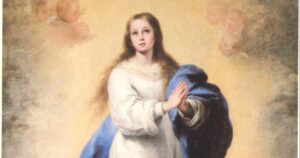
 “A great sign appeared in heaven: a woman clothed with the sun, with the moon under her feet and on her head a crown of twelve stars” (Rev 12:1).
The Immaculate Mary is the triumph of God. A complete triumph of God — that is Mary. In the Immaculate, God gives us a Mother who fulfills every aspiration, even those we could only dream of attaining. The Immaculate is an extraordinary masterpiece of the Holy Spirit. Mary is a wonder in whom what we have discovered remains far beneath what can still be discovered.
Mary is the One worthy of trust. The highest guarantee lies in perfect holiness. In Her I can place all my confidence.
She is entirely the light of holiness. There is in Her no deviation. There has never been in Her any alliance — even fleeting or minimal, even in the slightest imperfection — with the devil, our enemy, the principal and mortal enemy, the one who always lies at the root of all hostility against us, sustaining and inflaming every enmity.
United with Her, you will detest sin and reject sin. To have an Immaculate Mother is a treasure that can never be sufficiently praised. Place yourself under Mary’s guidance: the path She points out to you is a straight and secure road toward an encounter with God.
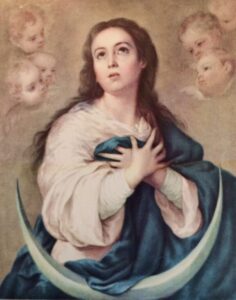 On December 8, 1854, Pope Pius IX proclaimed through the bull Ineffabilis Deus the dogma of the Immaculate Conception of the Virgin Mary. That is, the Virgin Mary had been preserved by God, from the very instant of her conception, through the merits of Christ’s redemption, from the original sin inherited by all humanity through Adam’s transgression, in order to prepare the most perfect Mother for His Son.
However, the sensus fidelium — the instinct of the faithful people — had long preceded the formal definition of the dogma, dating back to the earliest centuries. Especially in the East, the Church celebrated Mary’s purity. The Fathers of the Church called her Panaghia, meaning “All-Holy,” sanctified by the Holy Spirit, a “most pure lily,” the “Immaculate.”
In the West, ecclesiastical tradition always maintained the doctrine of the Immaculate Conception, though the development of the dogma became linked to theological reflection on original sin, a process that unfolded over many centuries until its solemn definition.
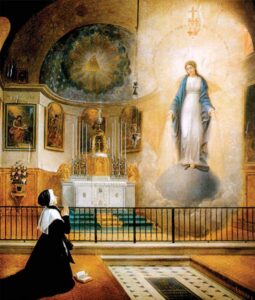 In 1830, the Blessed Virgin appeared to Saint Catherine Labouré and entrusted her with the mission of spreading throughout the world the “Miraculous Medal,” bearing the image of Mary and the inscription: “O Mary conceived without sin.” Its spread and devotion among the faithful became so great that many bishops requested from Pope Gregory XVI the definition of the dogma of the Immaculate Conception, and later from his successor, Pope Pius IX, who established a commission to carefully examine everything concerning the Immaculate.
Finally, he defined “that the doctrine which holds that ‘the Most Blessed Virgin Mary, in the first instant of her conception, by a singular grace and privilege granted by Almighty God, in view of the merits of Jesus Christ, Savior of the human race, was preserved free from all stain of original sin,’ has been revealed by God and therefore must be firmly and constantly believed by all the faithful.”
In 1858, the Blessed Virgin wished to confirm the proclamation of the Dogma of the Immaculate Conception, declared four years earlier. She appeared at Our Lady of Lourdes apparitions to Saint Bernadette Soubirous and, when asked by the young girl who She was, the Mother of God replied: “I am the Immaculate Conception.”
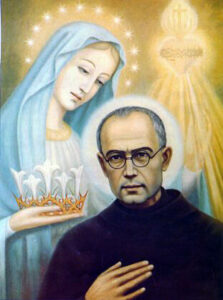 Saint Maximilian Kolbe (+1941), martyr of charity and called “the madman of the Immaculate,” invited souls to consecrate themselves completely to Her:
“The one who belongs more completely to the Immaculata will approach with greater boldness and freedom the wounds of the Savior, the Eucharist, the Heart of Jesus, and God the Father.”
“In practice, we know that souls who have given themselves to the Immaculata completely and without limits come to know Jesus Christ and the Mystery of God more deeply. The Mother of God cannot lead anyone anywhere except to the Lord Jesus.”
Saint Anthony Mary Claret (+1870), writing in his diary about the time when he served as Archbishop of Cuba, relates:
“On July 12, 1855, at five-thirty in the afternoon, when I finished the Pastoral Letter on the Immaculate Conception, I knelt before the image of Mary to thank her for helping me write that letter, and suddenly and unexpectedly I heard a clear and distinct voice from the image saying to me: Bene scripsisti (well written). Those words made a very profound impression upon me, together with a great desire to become perfect.”
Saint Germanus of Constantinople (8th century) did not hesitate to affirm:
“No one, O Most Holy One, is saved except through you; no one, O Immaculate One, is freed from evil except through you; no one, O Most Pure One, receives the gifts of God except through you.”