


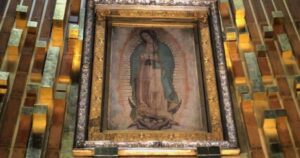
 The image of the Blessed Virgin of Guadalupe, imprinted on the tilma of Saint Juan Diego, has been studied by various scientists and, because of the wonders that have been discovered, we can conclude that it is a true work of divine art.
A tilma is a kind of cloak worn by country men tied over the shoulder, like a long apron, which they also used to gather the fruits of the harvests.
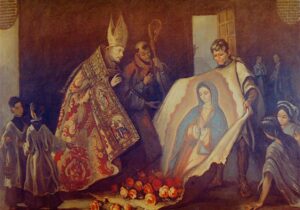 The Blessed Virgin used her image imprinted on the tilma as a sign so that the Bishop would believe what Juan Diego was saying and, although the material was a coarse ayate and that event occurred between December 9 and 12 of the year 1531, today, and to confuse the most skeptical, it remains in very good condition.
The studies carried out by scientists reveal that the image has impressive elements, difficult to reproduce, that go beyond what man with his own hands could accomplish. Certainly the tilma of Guadalupe contains a variety of supernatural elements and became the most important canvas in Christianity after the Holy Shroud.
Interesting details about the findings discovered in the tilma of Our Lady of Guadalupe are related to the eyes, the Virgin’s mantle, the incorruptibility of the tilma, and the coloration of the image.
The eyes of Mary
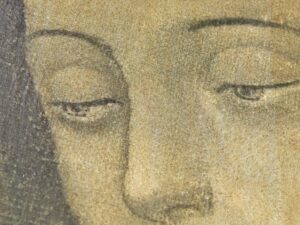 Studies carried out by specialists on Mary’s eyes have detected that when light is brought close to them, the retina contracts and when the light is removed, it dilates again, exactly as happens in a living person.
Likewise, when examining the eyes with 2,500 magnifications, it was identified that they reflect an image with individuals in different proportions, just as a human eye is capable of reflecting an image, and apparently this corresponds to the moment when Juan Diego shows the tilma with the roses to the Bishop (with other people also being present at that moment).
Using a computer, Dr. Aste enlarges the image of the pupil of the right and left eye in digitized form and discovers twelve people being observed by the eyes of the image of the Virgin of Guadalupe. But the surprise does not end there, since when enlarging the pupil of Bishop Juan de Zumárraga another thousand times more — that is, 1 millimeter of the image is first enlarged 2,500 times and then the bishop’s pupil another 1,000 times more — there appears once again the image of the Indian Juan Diego showing the tilma with the image of the Virgin of Guadalupe, portrayed in the bishop’s eyes. The image is portrayed twice: once in Mary’s eyes, and then in the bishop’s eyes portrayed in Mary’s eyes.
Image or real presence?
 The temperature of the maguey fiber with which the tilma is woven maintains a temperature of 36.6 degrees centigrade, the same as the body of a living person.
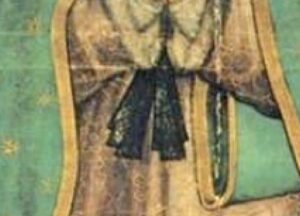
One of the doctors who analyzed the tilma placed his stethoscope below the ribbon worn by the Blessed Virgin (a sign that she is pregnant) and heard heartbeats rhythmically repeating at 115 beats per minute, just like a baby in the mother’s womb.
The cloth and the colors
No trace of paint or brushstroke has been discovered on the tilma. It contains neither natural dyes, nor minerals and animal substances. Nor substances known on the planet.
Another surprising fact is that the colors of the image do not impregnate the cloth as happens with a painting. A test was carried out by passing a laser beam between the cloth and the “painting,” and it was proven that the colors are not adhered to the cloth, but appear to be floating.
Science cannot explain the origin of the tilma’s incorruptibility because more than 500 years have passed and it remains intact. By itself, the maguey fiber with which the tilma is woven cannot last more than 20 or 30 years.
There was also a surprising event that occurred in the year 1791: the upper right side of the cloth was miraculously restored within a period of 30 days after muriatic acid had fallen on it. Today only a slight discoloration can barely be noticed in that place, testifying to what occurred.
The Virgin’s mantle
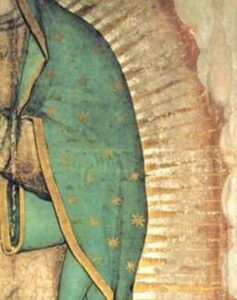
The stars on the mantle of Our Lady of Guadalupe reflect the exact configuration and position that the sky of Mexico presented on the day the miracle of her apparition took place.
All 46 brightest stars surrounding the horizon of the Valley of Mexico can be identified in their entirety and in their place, somewhat compressed.
A failed attack
At the beginning of the 20th century a man placed a bomb on the altar of the Virgin of Guadalupe. The bronze crucifix presiding over the altar was twisted by the impact of the explosion. The tilma remained intact.
The sanctuary
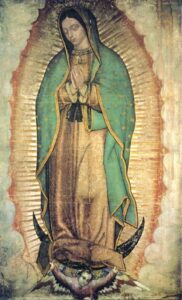 Saint Mary of Guadalupe wished for a temple to be built in her honor in order to show and give all her love, compassion, help, and protection, as she manifested to Saint Juan Diego.
That temple is today the Insigne and National Basilica of Saint Mary of Guadalupe, located at the foot of Tepeyac Hill in Mexico City. There we can visit our pious Mother — as she herself wished to be called — and contemplate her in that beautiful tilma that has performed so many miracles, especially of conversion, throughout history.
This event of the apparition of Our Lady of Guadalupe and her image on the tilma, while being a surprising miracle, is also an invitation to continue believing and trusting in the maternal love of our Mother, who wished to remain among her people.
That apparition in Mexico to a humble and simple man continues to be renewed today in those who allow themselves to be surprised by Mary’s tenderness, grace, and goodness, and in those who, with humility, are capable of opening their hearts and receiving the message of love that our Mother, Queen of heaven and earth, wishes to give them in order to lead them to a personal encounter with God.