

In the year 1965,
Fr. Luis Gallego was a young seminarian and was bidding a final farewell to his deceased father.
Deep within his heart, he meditated on “Mary’s presence” at the crucial moment of death and on his father’s salvation. These were not dark or destructive thoughts that tormented him. No. Rather, they were thoughts of joy and happiness inspired by the One to whom he had so often prayed with faith in the Hail Mary: “pray for us sinners, now and at the hour of our death.”
One phrase summarizes Mary’s intercessory power at the final moment of earthly existence:
“Not because of our merits, but through the intercession of the Blessed Virgin Mary, we shall all attain the fullness of Christ.”
How is the face of Our Lady of the Encounter with God defined?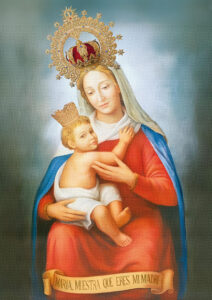
Nearly twenty-five years after his father’s death, Fr. Luis Gallego, already established in his parish of Villanueva de los Infantes, was inspired to place an image of this deeply beloved title of Mary in the apse of the parish church.
He asks a married couple for help
As a good parish priest, he found exceptional support in a married couple living in Infantes: Paquita and her husband Loreto. In a privileged way, they became co-promoters of the devotion, dedicating their souls, lives, and all that they possessed to spreading the memory and presence of this Mother, publishing books and offering their time and personal resources generously.
A ceramic image: the first representation
Ceramic material was used for the first depiction of the face of Mary of the Encounter, a technique widely used in Spain for decades.
“Now a face was needed” that would give visibility to this maternal mission of Mary. “Paintings and drawings of the Virgin were sought in the desire to find a Marian expression that fulfilled our hopes: she should be a Virgin who inspired piety, who held the Child in her hands, who looked modestly toward humanity, who harmonized with the structure of the church, who was beautiful and who led us to prayer.”
With angelic intention, it was desired that merely gazing upon her would awaken an intimate remembrance of the Mother, and that this remembrance would blossom into communion with God and with our brothers and sisters. To look upon Mary necessarily leads us to the Other and to others.
How did the name “Encounter” arise?
How should she be called when she so wonderfully assists us and leads us into the embrace of God, into communion with the Trinity, in the bitter passage of death?
And while reflecting and praying, the fitting title came from the lips of Loreto. He pronounced the word “Encounter” with simplicity and clarity born of a higher light. Fr. Luis immediately embraced the inspiration as the best expression of Mary’s role and mission: she is the One who leads us and brings us into the “Encounter” with God.
“Encounter,” attributed to the Mother of Jesus, sprang forth spontaneously, through the power of the Holy Spirit, in the heart of a simple man deeply in love with the Virgin Mary. And the parish priest perceived in that word the living Heart of Mary within the image. Nomen est omen — the name is a sign; it defines and reveals a reality.
Yet it would no longer refer only to the definitive “Encounter” with God after crossing the threshold of death into eternal life. It would also extend to every daily “encounter” with God, and, from God, to every “encounter” with our brothers and sisters, each one made in the image of God.
That day was chosen by the God of names and persons to “baptize” the new title: Our Lady of the Encounter with God.
The final image of the painting takes shape — June 1996
A young painter from La Mancha, Pedro Miguel Pérez Villegas, emerged and completed the painting on canvas envisioned by Fr. Rodrigo Molina, which remains the official image to this day.
“May it inspire piety; may it hold the Child in her hands; may it look upon humanity; may it be beautiful… may it lead us to prayer; may it bear the inscription: ‘Mary, show that you are my Mother,’ so that simply reading it becomes a prayer.
(...) The message of the painting should be this: Mary looks at us and says: ‘This is my Son; I present my Son to you; I lead you to Him and continually prepare your encounter with Him.’”
These places sought to resemble “a Golgotha beside Mary,” “under Mary’s shadow, united with Mary, so that in her we may have the encounter with God.” An encounter with God that “necessarily” leads to an encounter with our brothers and sisters — with humanity, which longs for the love for which it was created. In general, it is an encounter with every person in all dimensions, and with each individual person in a unique way.
What is the meaning of the phrase: “Show that you are my Mother”?
Every time we gaze upon the painting and read these words, we make not only an affirmation of the motherhood of the Blessed Virgin Mary, but also a true personal prayer:
“Mary, show that you are my Mother.”